




 Delaware (USA)
  Vietnam
  Singapore
  Hong Kong
  United Kingdom
 Replace a lost TRC in Vietnam immediately to maintain legal residence status, as losing it may compromise your ability to live, work, and travel legally. The Vietnam Immigration Department processes temporary residence card replacements. Foreign residents submit police loss reports, immigration forms, and valid passports to request a new card. This guide explains the exact process to replace a lost or damaged TRC, the required documents, and the legal risks of delay.
Why must you replace a lost TRC in Vietnam immediately?
Foreigners must replace a lost TRC in Vietnam immediately to avoid immigration penalties. Delays create severe problems for travel, employment, and daily life in the country. The government requires foreign residents to carry valid identification at all times. A lost TRC limits your ability to prove your legal status to local authorities. Immediate replacement prevents long-term legal complications. Taking fast action secures your residence rights.
Replace your missing card to achieve the following outcomes:
- Prevent immigration fines during routine police checks.
- Maintain legal employment status with your sponsoring company.
- Enable domestic flights and international travel.
- Allow smooth visa or work permit renewals in the future.
- Verify identity for banking, healthcare, and housing services.
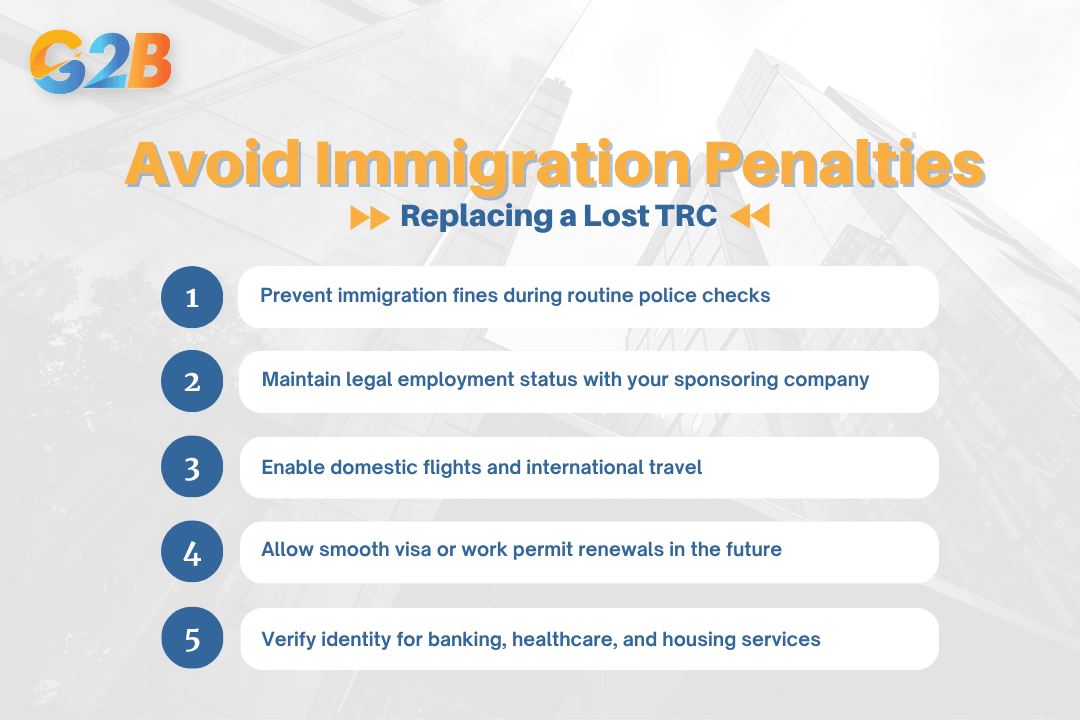
Foreigners must replace a lost TRC to avoid immigration penalties
What happens if you do not replace a lost TRC in Vietnam?
Failing to replace a lost TRC causes immediate administrative and legal issues. The Vietnam Immigration Department monitors foreign residents strictly. Missing immigration documents trigger extra scrutiny during official checks. Local police conduct regular residence inspections in foreign expat neighborhoods. Without a valid TRC, you cannot prove your legal right to stay in the country. Employers also face severe penalties if their foreign staff lack proper documentation.
Ignore the replacement process and face these specific consequences:
- Face difficulty proving legal residence status to local police.
- Encounter problems during exit or re-entry at international airports.
- Experience delays in visa, work permit, or TRC renewals.
- Receive extra scrutiny from local immigration officers.
- Cause employer compliance issues during official labor audits.
- Pay administrative penalties and fines for late reporting.
Step-by-step guide to replacing a lost TRC in Vietnam
Applicants follow a five-step process to replace a lost or damaged TRC. The procedure requires coordination between the foreign resident, the local police, and the sponsoring company.
Step 1: Report the loss to local police
Foreigners report the loss to the ward police station where they register their residence. The police officer issues a stamped loss confirmation report. This document proves the card is missing and serves as the foundation for your replacement application. The ward police (Cong An Phuong) manage local security and residence tracking. You must visit the specific police station that handles your registered apartment or house.
Follow these steps at the police station:
- Visit the local police station immediately after noticing the loss.
- Bring your valid passport and temporary residence registration book.
- Fill out the official loss report form provided by the officer.
- Detail the exact time, location, and circumstances of the loss.
- Request a police loss confirmation report with an official red stamp.
Warning: Failure to report promptly may lead to fines or application refusal by the immigration department.
Step 2: Prepare the required documents for TRC replacement
Sponsoring companies and foreign applicants gather specific immigration documents for the replacement. The dossier includes application forms, identification, and police records. The sponsoring company plays a major role in this step. The company must sign and stamp the required immigration forms. Family-sponsored applicants rely on their Vietnamese spouse or primary TRC holder for these signatures.
Prepare the following items carefully:
- Write a reissuance request from the sponsoring company or individual.
- Provide the original police loss report with the ward police stamp.
- Write a damage explanation if you are replacing a damaged card.
- Submit a valid passport with sufficient remaining validity.
- Provide a valid visa or legal entry documents.
- Include the residence registration certificate from the local police.
- Attach two passport photos measuring 2x3 cm with a white background.
- Submit the original TRC if the card is damaged but not lost.
- Provide a sponsor responsibility letter if the immigration office requests it.
Step 3: Submit the TRC replacement application
Applicants submit TRC replacement files to the Vietnam Immigration Department or the Provincial Immigration Office. The correct location depends on the sponsoring company's registered headquarters. Central immigration offices handle complex cases and specific visa categories. Provincial offices process standard labor and family TRCs. Submitting the file to the wrong office delays the entire procedure.
Submit your application to one of these locations:
- Visit the Vietnam Immigration Department headquarters in Hanoi or Ho Chi Minh City.
- Visit the Provincial Immigration Office where the foreign applicant resides.
- Submit documents through official legal representatives or agencies.
Step 4: Pay the TRC processing fee
Applicants pay between USD 10 to USD 100 to replace a lost TRC. Fees vary based on the TRC type, validity duration, and specific government regulations. The government sets flat state fees for immigration documents. A one-year TRC costs less than a three-year or five-year TRC. The immigration officer calculates the exact fee upon reviewing your dossier.
Manage your payments through these steps:
- Check the current fee schedule at the immigration office counter.
- Pay the required state fee in Vietnamese Dong (VND).
- Receive an official payment receipt from the cashier.
- Keep the receipt safe to collect the new card later.
Step 5: Receive the new TRC
Foreign residents receive the new TRC at the immigration office after processing finishes. The applicant must bring the receipt note and passport to collect the card. Processing times depend on office workload and file completeness. The receipt note indicates the exact date to return to the office.
Complete the collection process safely:
- Check the return date printed on the official receipt note.
- Visit the immigration office during designated return hours.
- Present the receipt and original passport to the counter officer.
- Verify all printed details immediately after collection.
- Check the spelling of your name, passport number, and validity dates.
- Report any printing errors to the officer before leaving the building.
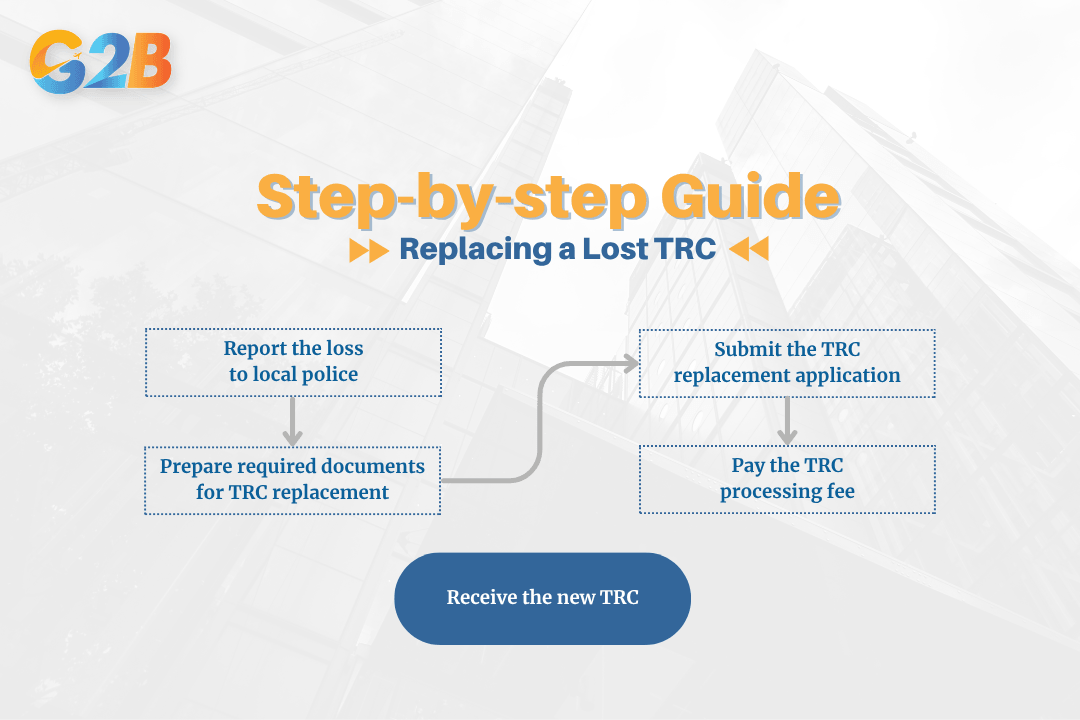
Step-by-step guide to replacing a lost TRC in Vietnam
What is the required documents checklist for a lost TRC replacement?
A complete document checklist prevents application rejections. The immigration office demands original documents, official forms, and accurate photographs. Comparing the requirements for lost cards versus damaged cards helps applicants prepare the correct dossier. Missing a single stamp causes automatic rejection at the submission counter.
Review the required documents checklist below:
| Document | Usually required for lost TRC | Required for damaged TRC |
|---|---|---|
| Passport | Yes | Yes |
| Police loss report | Yes | No |
| Sponsor request letter | Yes | Yes |
| Residence registration | Often | Often |
| Visa / legal stay proof | Yes | Yes |
| Photos 2x3 cm | Yes | Yes |
| Original damaged TRC | No | Yes (Damaged cases only) |
| Responsibility letter | Sometimes | Sometimes |
How long does a lost TRC replacement take in Vietnam?
The Vietnam Immigration Department usually replaces a lost TRC within several working days, depending on the local office and dossier completeness. The timeline begins only after the immigration office accepts a fully complete dossier. Incomplete files stop the clock. The office requires extra time to verify company statuses or background information in certain situations.
Expect timeline variations based on these factors:
- Submit complete dossiers to ensure standard processing times.
- Expect delays when documents are missing or inconsistent.
- Prepare for longer wait times during national holiday periods.
- Anticipate slower processing during peak application seasons.
What are the common mistakes that delay TRC replacement?
Applicants delay TRC replacements by making document and procedural errors. Immigration officers reject files that contain outdated forms, missing stamps, or incorrect photo formats. Simple administrative mistakes force applicants to restart the entire process. Sponsoring companies often fail to update their legal representative signatures, causing mismatch errors in the government database.
Avoid these common mistakes:
- Do not delay reporting the loss to the local police station.
- Do not forget to include the original stamped police report.
- Do not submit an expired passport or one with less than six months of validity.
- Do not use the incorrect photo format or colored backgrounds.
- Do not submit incomplete sponsor documents without the company red stamp.
- Do not use outdated immigration forms downloaded from unofficial websites.
What is the fastest way to replace a lost TRC in Vietnam?
The fastest way to replace a lost TRC requires immediate action and accurate document preparation. Applicants use professional consulting services to expedite the process. Professional services help foreign experts and businesses prepare flawless dossiers. They understand exact immigration requirements and communicate directly with local authorities.
Execute these steps for the fastest results:
- Report the loss immediately to local ward authorities.
- Inform your sponsor or employer on the same day.
- Gather documents the same day using professional agency guidance.
- File early with the immigration department to beat the queues.
- Track application progress online or through the official receipt.
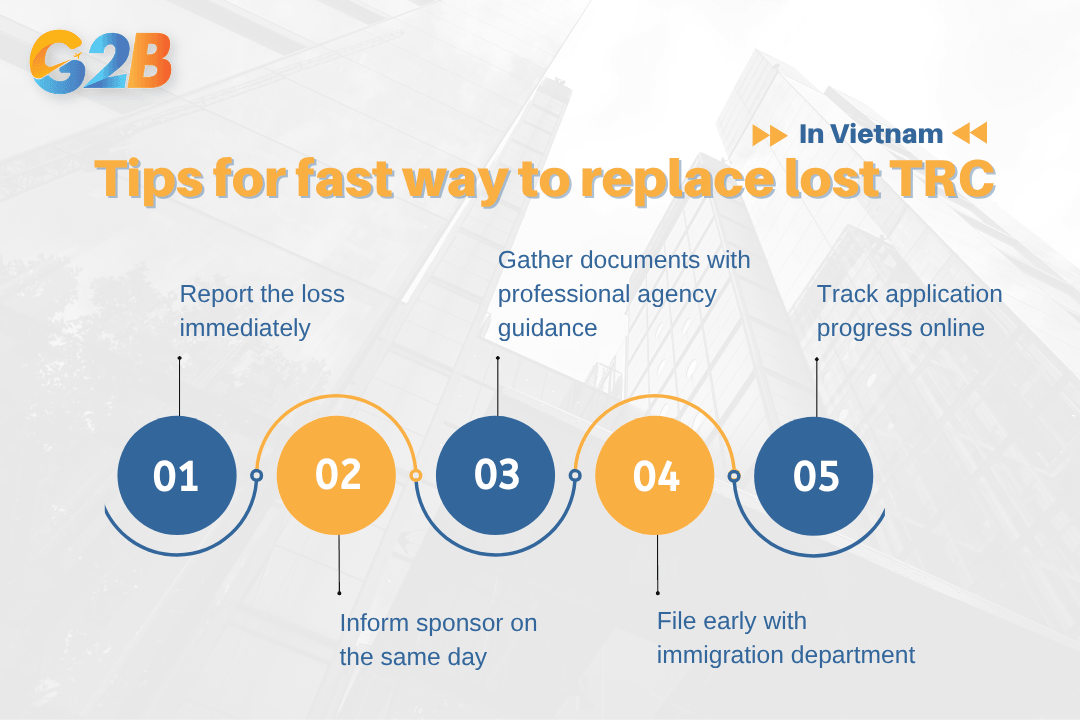
Tips for the fastest way to replace a lost TRC in Vietnam
What are the differences between replacing a lost TRC and a damaged TRC?
Replacing a damaged TRC requires surrendering the broken card, while a lost TRC requires a police report. The Vietnam Immigration Department treats both cases as reissuance requests. If a TRC breaks, fades, or snaps in half, it becomes invalid for travel and identification. You do not need to visit the police station for a damaged card. Instead, you write an explanation letter detailing how the card became damaged. You must hand the physically damaged card to the immigration officer during submission.
Submit these specific items for a damaged TRC:
- Write a formal explanation letter regarding the damage.
- Surrender the original damaged Temporary Residence Card.
- Provide the standard sponsor request forms and passport photos.
- Skip the police loss confirmation report.
How does a lost TRC affect your employment and travel?
A lost TRC pauses your ability to travel internationally and complicates human resources compliance. Airlines deny boarding to foreign residents who cannot present a valid visa or TRC. Your sponsoring company relies on your TRC to prove legal employment to the Department of Labor. During standard labor audits, companies must present valid residence cards for all foreign staff. A missing TRC places the company at risk of administrative fines. Furthermore, you cannot register new bank accounts, sign rental leases, or apply for foreign visas at embassies within Vietnam without your physical TRC.
Manage your daily activities carefully during the replacement wait time:
- Cancel or postpone international flights until you receive the new card.
- Carry your valid passport and a copy of your police loss report.
- Inform your human resources department immediately to update their records.
- Avoid crossing land borders without proper physical documentation.
Frequently asked questions about replacing a lost TRC?
Is police reporting mandatory after losing a TRC?
Yes, the immigration department often requires a police loss report for replacement cases. The local ward police must stamp and sign this document to prove the loss occurred legally.
Can I travel without my TRC?
Travel may become difficult and risky without a physical TRC. Foreign residents must replace the lost TRC first before attempting international travel or airport exit procedures.
Can my company apply for me?
Yes, many cases require sponsor involvement. The human resources department or a designated legal representative from the sponsoring company usually submits the application on your behalf.
How much is the replacement cost?
The cost depends on the card type, duration, and current state fees. The typical state fee ranges between USD 10 and USD 100, payable directly to the immigration office.
Can damaged TRCs be reissued?
Yes, damaged cards are commonly eligible for replacement. The applicant must surrender the original damaged TRC and provide a written damage explanation instead of a police report.
Replacing a lost TRC protects foreign residents from legal penalties and travel restrictions in Vietnam. The process requires an immediate police report, correct immigration forms, and direct support from the sponsoring company. The Vietnam Immigration Department processes these applications efficiently when applicants provide complete and accurate dossiers. Missing documents, incorrect photos, or delayed police reporting cause unnecessary waiting periods and administrative friction. Foreign workers, investors, and family members must store their physical cards safely to avoid these disruptions.
When accidents happen, taking immediate action secures your legal residence status and prevents employer compliance issues. Businesses and individuals regularly use professional consulting teams to navigate these strict immigration regulations smoothly. Preparing the correct dossier ensures a fast return to normal daily activities, safe international travel, and compliant living inside Vietnam.
